I have been studying how to make my stories better. Lately, this new knowledge has been helping me to see when story elements don't work. Of course, I'm still trying to figure out what does work, but I figure this is a step in the right direction.
For instance, this morning I was watching a Star Wars Clone Wars episode with my son. Now, I've been a huge Star Wars fan since 1978 (I grew up with Luke Skywalker - we were kids together) and was real excited when I heard about a cartoon series coming out set in the Star Wars universe. For some reason, though, I have not been able to get into these shows; they just don't capture my interest. I have to force myself to sit through them, but the kids like them so I just can't delete them from the DVR.
The episode I saw today helped me see a possible reason why I can't get into them. It was episode 3.8 "Evil Plan" [warning - spoilers follow] where R2 and C3P0 are sent on a mission to get some special fruit. Anakin sends R2 with C3P0 to be the "responsible" one on the trip. The two droids manage to get the fruit, but then another droid that was working for a bounty hunter tries to persuade them to go to a "droid spa." R2 insists that it wants to go while C3P0 wants to stick to the mission. They split up. C3P0 gets captured and interrogated by the bounty hunter while R2 enjoys a luxurious cleaning at the spa. Since C3P0 was clueless, the hunter decided to send his minions to go get R2, who just happened to be getting out of the spa.
Now, this bothered me on several levels. First off, it immediately struck me as out of character for R2 to want to abandon the mission for a little luxury. At least in my mind, R2 is a responsible, no-nonsense character who would stick to the mission, no matter how small, no matter what. And then, for R2 to frivolously spend the remaining credits that Anakin charged him with keeping track of also goes against its character. Also, it seemed way too convenient for R2 to still be in the area for when the bounty hunters came back to retrieve him. Lastly, C3P0 dropped the cylinder of fruit in a part of town with a lot of foot traffic. It was still there later when the episode ended, so they could just go pick it up and take it back to Anakin. No one stole it, kicked it, ran over it, or threw it away after what had probably been hours in their time. That was a convenience that stretched credibility.
So, why did they do that? As a writer, their reasons seem clear to me. They needed something, first of all, to split up the two droids. Then, they needed something that would keep R2 in a convenient place for later. Now, I understand this dilemma: when you need your characters to be in certain places so that plot elements can happen. Our challenge is to do this in such a way that it seems natural. In this case, it seemed very unnatural because it violated R2's character for me, and thus, caused me to disconnect from the story.
How could they have solved their situation? Many ways of course. One, they could have had C3P0 abducted while the sales droid pestered them, then R2 could have gone off to try to rescue his buddy. One problem with that plan is R2 is the smart one and would try to contact someone for help. In order for that scenario to work, R2 would have to somehow be blocked from finding help. Or another idea would have been for both of them to be captured and then, once the bounty hunters couldn't get anything from C3P0 they would turn to R2. I think the reason they didn't do this is because they wanted to show the contrast between C3P0 being tortured one second and then switch to R2 enjoying the comforts of the spa. That's not a bad idea, but they had to contort the character to make it happen. I think this was a "darling" that the writers put in that needed to be killed.
What makes us enjoy stories is seeing characters that we can relate with overcoming obstacles in order to become better people. It just doesn't work when the characters have to be changed in order to make a plot work.
Showing posts with label characters. Show all posts
Showing posts with label characters. Show all posts
Saturday, January 1, 2011


Tuesday, December 14, 2010
Save the Cat!
I recently finished reading the Save the Cat! trilogy of books by Blake Snyder called: Save the Cat!, Save the Cat! Goes to the Movies, and Save the Cat! Strikes Back. These are advice books geared toward writing movie scripts but I have found them very informative in helping my novel and short story writing.
I don't even know where to begin to describe all the new epiphanies they gave me, but I'll start with this one simple thing: All stories are about transformation. Maybe this is old hat for some of you, but I have a tendency to think of interesting situations and then throw some characters in to see how they do without any thought of what it will do for the character. Yeah, sometimes I accidentally do get some kind of a character arc going, but it has mainly been hit or miss. I talked more about this in my last blog entry when I discussed character arcs.
The most useful thing I got out of it was what he calls the "Blake Snyder Beat Sheet". It's where he breaks movie plots down into 15 beats, or plot points, that virtually every successful movie follows in some form or another. What he does in Save the Cat! Goes to the Movies is apply his beat sheet to 50 popular Hollywood movies to show how this is true. That was very useful to me, since I learn best by example than with pure theory. You can download a copy of his beat sheet (among other things) at blakesnyder.com under the "tools" tab.
For fun, I tried it with a few movies I've seen recently: How the Grinch Stole Christmas (with Jim Carrey), The Santa Clause (with Tim Allen), and Avatar (with really tall blue dudes). Sure enough, it worked. It also opened my eyes to deeper meanings in the movies that I didn't see when I just sat and passively watched. It made me realize that I need to incorporate some of these elements into my own writing.
What are those elements, you may ask? First off, that the character needs to change from the beginning to the end of the story. Also, a story, in order to resonate with us more, needs to have some kind of theme that is stated near the beginning.
I could go on and on about several other little things I learned. Maybe I'll save some of those for future blogs. The bottom line, though, is that if you want to gain more insights into your writing and story telling, you must read at least the first Save the Cat! book. I wish I'd learned about it earlier in my writing career.
Thursday, December 9, 2010
Character Arcs, I Get It! . . . I think
This week, I've had an epiphany (isn't that such a cool word?). For the last several years, and more recently from my writing group, I've kept hearing about the need for character arcs. Well, I think I finally get it! (okay, so I'm a little slow)
I think one stumbling block I've had before this new realization is the old saying: character + problem = story. It's a very simple formula, and I like things that are simple (I'm very simple-minded), but I've come to the conclusion that this formula is too simple. True, it works, but what is it that makes a story stand out and stick with us? What makes a story great? I think I know the answer now, though as I continue to learn of this concept, that might change.
It's taken a combination of things to help me learn this. Most recently, my writing group (with Bryan Beus and Steven Gashler, thanks guys) have been asking me what my characters' arcs are. I always had the brilliant answer of, "Idunno." Wasn't it just good enough that my character was stuck into some insurmountable situation and we get to see them figure a way out? Well, it does work to create a "fun" story, and there are plenty of books and movies that follow this formula. But is it even necessary to make some kind of philosophical statement, too? Probably not, but isn't it also nice to write a story that sticks with people and causes them to want to read more of what you have? Most definitely. And we do this with the arcs.
Lately, during my morning exercise bike routine, I've been rewatching my Babylon 5 DVDs. This series has always stood out to me and until now I didn't quite know why. Actually, a couple of episodes I've recently watched stood out as good and bad examples of what I mean. In season 4, there was an episode called "Intersections in Real Time." It's where Captain Sheridan is being held prisoner. To make a long story short, the end of the episode finished with him in the exact same position he had started. I let out an audible groan when it was over. I couldn't believe I had sat through (actually, I pedaled) that whole thing. What a waste of time!
Towards the beginning of Season 5, there was another episode called, "The Long Night of Londo Mollari." I groaned as it started. This episode did not have any fancy explosions or high excitement.We got to spend most of the episode inside the dying brain of Londo. How boring could that be? It actually ended up being a great episode. Why? Because Londo made a journey and came to the other end of it a changed person.
Another reason I think I've always gravitated toward simple "character with problem" stories is because most of our television series do this. Characters might make a small arc during one episode, but by the next week they were all reset back to square one. Very seldom do we see series characters learn and change. That is why a couple of my favorite shows have been Babylon 5 and Star Trek: Deep Space 9. I could go on about this, but I won't for now.
Now, the third thing that has helped me on my quest to understand this is the Save the Cat! series of books by Blake Snyder. I'll do another blog about this later, but in Blake's beat sheet (outlining) method, he builds in the concept of character change. He points out that what resonates with the audience is not only the A story (plot - the sequence of events) but also a B story that contains some form of spiritual lesson. I'll probably go into this more in my next blog.
Okay, so now the old formula is all messed up. Since I really like formulas, though, I've been trying to come up with a new one. How about this: Character (from beginning of story) divided by Situation That Forces Change equals Character (at end of story). Or, more succinctly: CharB / Change = CharE. Hmm, maybe it needs to be inserted into the quadratic formula somehow.
So, what I think I've learned is that stories are not about fancy worlds or great action sequences, though those are fun, but they are about exploring the human condition in order to see how people learn and grow. I'd appreciate any thoughts others have on this, and other "formulas" for fiction. I'm not sold on my formula being the right one, but it's a place to start. Please feel free to leave a comment.
Friday, January 22, 2010
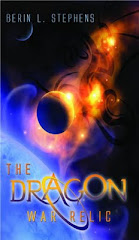
Dragon War Relic characters
I've started this post several times at night when my brain was functioning like Jello. Actually, Jello probably would have been able to think more clearly than I. Anyway, I'm trying it in the morning this time before my brain becomes another gelatinous mess.
I've had several questions from people about how I created my characters. The short answer is: I don't know. It comes down to the fact that I'm a discovery writer and I just sit down and improvise. The characters, like Athena from Zeus, seem to pop out of my head fully formed. I don't do any long work sheets to figure out where they were born or what their favorite food is. Details just come to me as I write. I've said this before, but I feel like I access the same part of my brain when I write as when I improvise jazz.
Okay, now for the long answer. I still had to make some decisions about the characters, so here's a break down on some of those decisions:
Jared: He's a lot like I was as a teenager, except he's smarter, more motivated, and a lot less messy. I wanted someone who was kind of an anti-Harry Potter. Not that he's the opposite, but I wanted him to be a good student who could figure things out on his own, unlike good ol' HP who needed Hermoine's help. I also used the color code theory on personality, so I made Jared a blue.
Doug: Color code: yellow. He was pattered after some guys I knew in California and in college. He might be a little dated, since he would have fit right in with California culture in the 80's. He's also a little like I wanted to be as a teenager but was afraid to be.
Gar: Gar is a blue-red. He's also a little like I am now as an adult. I wanted someone who was serious and fun. My kids first compared him to Hagrid, but in my mind he's a little more like Ford Prefect from Hitchhiker's Guide.
Kayla: She is the hardest character for me to relate to. Naturally, I kept unconsciously making her docile like an angel, but I wanted her to be contrary to the stereo-typical angel, to be kind of a snot. What finally helped was that I cast an actress to play her part in my mind, but I won't say who. Of course, I'm still having this struggle with her in The Scepter of the Ancients. She's a red. Maybe that's why I struggle with her since I'm a white.
Sprock: Of course, he's a big fan of Mr. Spock from Star Trek. But where Spock is outspoken and unemotional, Sprock is shy and very emotional. He's an extreme white.
Kerk, Sprock, and Bob: These three were originally just supposed to do comic relief cameos, but somehow they inserted themselves into the story. So between them and Doug (and Gar, to some extent) I have a cast of comedians and one very, ultra-serious person for them to make fun of.
Tyke: Of course, you don't know who Tyke is. He was a character who was cut from one of my failed drafts for book 2. My daughter, though, said he was one of her favorites, so I need to figure a way to get him back in. He's a former Angel fighter pilot (from the Angel-Demon wars) who now drives an air taxi on Angelon. He's also not your typical Angel: unshaven, sloppy robes, and dare-devil.
Let me know if you have any more questions.
Subscribe to:
Posts (Atom)